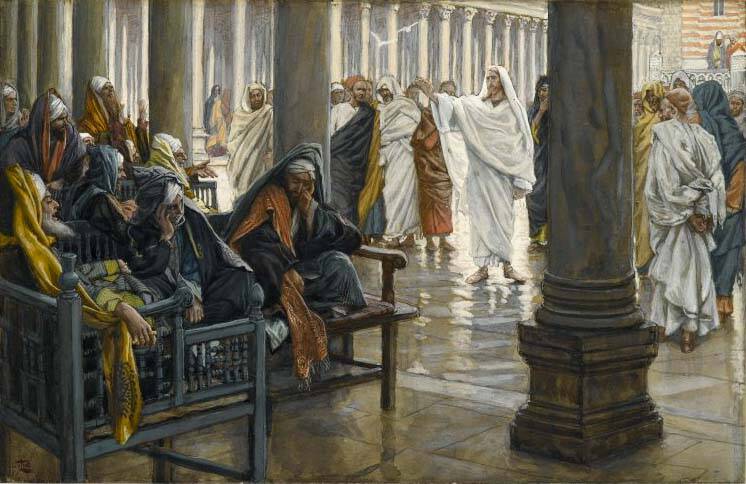
Going Through the Motions
The Spirit of Legalism is what turns many people off toward Christianity! "Religion" is man-made and is not about finding God, it is about what men make up about God, sometimes just to suit their own agendas! Jesus Himself got into arguments all the time with the Pharisees. The Pharisees were the ones who put Jesus on trial to be crucified! If they were truly of God, why would they be against Him when He was here? Jesus is NOT to be found in religion!
Legalism is a "dead end" because it is a bunch of made-up rules, that have little to nothing to do with God. You don't condemn the person, you condemn the sin, and you help the person find what God wants them to do.
Religion inhibits people from having a real connection with God.... the Bible warns against false teachers: http://www.youtube.com/watch?v=CxkXEVqpY7s
Legalism in the church is inexcusable, if more churches preached the Word of God with the anointing of the Holy Spirit, there would not be so many people not wanting to go every Sunday. It is also important to note that while different denominations of the Christian faith may be useful to the Kingdom in that they specialize in certain ministries, many of them get too caught up in rules and regulations.
There are churches that greatly emphasize "giving" and they even use Biblical verses incorrectly to support this, saying that God will bless you if you give. But this is wrong. It is between the individual and God. Related Article: http://www.letusreason.org/wf34.htm
There are many who argue that Catholicism was the beginning of Christianity, but this is why America was born- for religious freedom! Also, the initial Church would be more aptly described as Judeo-Christianity; they had Apostles and leaders- but no pope. The pope represents the corruption of the initial Church. The pope seems to be a religious president and takes the focus off of God, when that's what it's really about! Masses are very ceremonial and paganistic (usually not very anointed), people that participate in these kinds of religious services are not being spiritually fed... they are giving these Churches a paycheck.
This is not God's agenda: http://youtu.be/eAbhRxmA46I
The History of Christianity: http://www.gotquestions.org/history-Christianity.html
Origin of Catholic Church: http://www.eaec.org/cults/romancatholic.htm
Related Link about forged books that didn't make the Bible: http://www.gotquestions.org/Gnostic-gospels.html
A specific example of this would be the Gospel of Thomas: http://www.gotquestions.org/gospel-of-Thomas.html
Before the Church was established, God still dealt with peoples' salvation. Heaven wasn't yet prepared until after Jesus had offered up His blood into the Holiest of Holies. So, people who died prior (including Abraham) went into a comfortable part of hell, and Jesus went down there and preached the Gospel to them after His crucifixion (He preached to everyone, those in the bad part of hell also-it is even possible Judas reconnected with God). Jesus took the converts with Him to Paradise, which is the Third Heaven (the first heaven is earth's atmosphere, the second-outer space), where God the Father dwells. God is a good and just God, He makes sure that everyone has a true and conscientious choice to become born-again. Children and those who have never heard the Gospel, are not accountable. God deals with them accordingly.
Should a Christian Celebrate Easter and Christmas?: http://www.blogos.org/gotquestions/easter-sunday.html and http://www.gotquestions.org/Christmas-traditions.html
Women in the Church
In 1 Corinthians 11, Paul begins to instruct the Corinthian church about their somewhat disorganized worship services. He says that women should wear a head covering when they pray and prophesy; then he corrects the Corinthians on the way they had been observing the Lord’s Supper. In chapter 12, he addresses the proper use of spiritual gifts in the worship service. He describes a number of gifts and insists that all gifts are important to the Body of Christ; the variety of gifts calls for mutual respect and honor, not vanity or shame.
In chapter 13, he describes love as the best way, and in chapter 14 he makes an extended contrast between the gift of tongues and the gift of prophesying. Apparently, some people in Corinth were extolling the gift of tongues as a mark of superior spirituality. Paul did not tell them to stop speaking in tongues, but he did put some restrictions on how tongues should be used in the worship service:
1) There should be two or three speakers (14:27).
2) They should speak one at a time (v. 27).
There should be an interpretation. If no one can interpret the tongues, “the speaker should keep quiet in the church and speak to himself and God”. However, this requirement should not be lifted out of its context to create a complete prohibition on the person ever speaking, singing, or praying.
Paul is apparently trying to give some organization to what had been a rather chaotic worship meeting—several people speaking at once, speaking words that no one could understand.
Paul recommends the gift of prophecy as a far more helpful gift, but he gives similar guidelines for those speakers, too:
1) Only two or three should speak. If someone else has something to say, the first speaker should be quiet.
2) They should speak one at a time.
3) People should “weigh carefully what is said” (1 Thess. 5:21).
Paul notes that “the spirits of the prophets are subject to the control of the prophets” (1 Cor. 14:32). That is, the speakers are able to stop; they cannot use “God made me do it” as an excuse for adding to the commotion. When God gives a gift, he also gives the person the responsibility to make decisions to use that gift in an appropriate way. Simply having the gift is not an excuse to use it whenever and wherever the person wants to. Paul explains his reason: “For God is not a God of disorder but of peace”.
Paul then tells the women to be quiet, and to ask their questions at home: “As in all the congregations of the saints, women should remain silent in the churches. They are not allowed to speak, but must be in submission, as the Law says. If they want to inquire about something, they should ask their own husbands at home; for it is disgraceful for a woman to speak in the church”
The first thing we notice is that women are not the only people Paul tells to be “silent.” He uses the same word in verses 28 and 30 to tell tongue-speakers and prophets to be silent when others speak. In both of those verses, he is calling for a temporary silence, not a complete and permanent prohibition.
Paul says that instead of speaking, women should be in submission. This implies that the Corinthian women were speaking in an insubordinate way. The fact that Paul said in chapter 11 that women could pray and prophesy, and in chapter 14 that two or three people could prophesy in a worship service, shows that women are allowed to have a slot in the speaking schedule. It is not insubordinate for them to speak prophecies; it is therefore likely that Paul is prohibiting some less-formal speaking, such as chatter or comments from the audience. How is it that when we read the New Testament as letters to specific Churches that we would then lift the verse out of the Holy Bible for unholy legalism and out of context?
Paul says that “the Law” requires submission, but the Bible does not endorse submission of all women to all men. The Old Testament does not require all women to submit to all men, nor does it require them to be silent. The Bible is alluding to a rule about family relationships, it would not necessarily apply to authority in the church.
1Cor 12: 13 For by one Spirit are we all baptized into one body, whether we be Jews or Gentiles, whether we be bond or free; and have been all made to drink into one Spirit.
Gal 3: 28 There is neither Jew nor Greek, there is neither bond nor free, there is neither male nor female: for ye are all one in Christ Jesus.
Women Remaining in the Church:
https://rickeyholtsclaw.com/2021/03/11/must-women-remain-silent-in-church/
Titus 2:4-5 Commentary: https://biblicalpersonhood.wordpress.com/christian-myths-on-gender-and-gender-roles/myth-titus-24-5-commands-women-to-obey-their-husbands-to-stay-at-home-and-to-love-their-husbands-and-children/
1 Timothy 2:11-15 Commentary: https://www.gotquestions.org/saved-childbearing.html
Can Women Teach in the Church?- http://www.charismamag.com/life/women/21453-does-1-timothy-2-12-really-say-women-can-t-teach-in-church
Greek Word Oude- http://biblehub.com/greek/3761.htm
Related Videos:-
https://youtu.be/VIXKQb1E22s?si=SX5MWO0P_zuvFA2v
https://youtu.be/5Vv-E3n1ZTs?si=p0i2GxncQpkv1_yT
Can Women Teach Men?-
http://www.therefinersfire.org/women_teach_men.htm
https://www.comereason.org/bible-against-women.asp
https://versebyverseministry.org/bible-answers/must-women-remain-silent-in-church
1 Corinthians 11:7 Commentary: https://www.evidenceunseen.com/bible-difficulties-2/nt-difficulties/romans-2/1-cor-117-9-are-women-made-in-gods-image-or-mans/
Before Eve was created Adam was created in the image of God. Eve coming from man makes her of man. Bone of my bone, flesh of my flesh. Her being from the man also makes her of God. The two become one. But in the Spirit there is neither male nor female. For we all are vessels of The Lord. We both hold the same Spirit. However, in this life man is the head of the woman.
https://www.gotquestions.org/desire-husband-rule.html
Original Sin: https://www.gotquestions.org/Eve-sinned-first.html
Slavery in the Roman Empire and the Bible:
http://www.gotquestions.org/Bible-slavery.html
http://biblereasons.com/slavery/
Jesus Himself was not submissive to the unjust or irrational use of authority. He set a very different example. He often publicly pointed out injustice or hypocrisy, and frequently irritated or even enraged “the powers that be.” It is not possible to imagine the real Jesus of history coaching other people in door-mat-ness. That was just not his way of thinking or operating.
"You have heard that it was said, ‘Eye for eye, and tooth for tooth.’ But I tell you, do not resist an evil person. If someone strikes you on the right cheek, turn to him the other also. And if someone wants to sue you and take your tunic, let him have your cloak as well. If someone forces you to go one mile, go with him two miles. Give to the one who asks you, and do not turn away from the one who wants to borrow from you".- Matthew 5:38-42 There was Old Testament stoning, what God means here is to be non-violent, and it does also indicate that a Christian ought to be long-suffering in the faith but not put up with abuse.
Bible Verses Against Abuse (slaves are not to put up with extreme cruelty and abuse):
Psalms 18:48 He delivereth me from mine enemies: yea, thou liftest me up above those that rise up against me: thou hast delivered me from the violent man.
2 Samuel 22:28 And the afflicted people thou wilt save: but thine eyes are upon the haughty, that thou mayest bring them down.
Psalms 22:24 For he hath not despised nor abhorred the affliction of the afflicted; neither hath he hid his face from him; but when he cried unto him, he heard.
Psalms 140:12 I know that the LORD will maintain the cause of the afflicted, and the right of the poor.
Psalms 72:14 He shall redeem their soul from deceit and violence: and precious shall their blood be in his sight.
Psalms 9:9 The LORD also will be a refuge for the oppressed, a refuge in times of trouble.
Psalms 103:6 The LORD executeth righteousness and judgment for all that are oppressed.
Psalms 146:7 Which executeth judgment for the oppressed: which giveth food to the hungry. The LORD looseth the prisoners:
Hebrews 13:3 Remember them that are in bonds, as bound with them; and them which suffer adversity, as being yourselves also in the body.
Isaiah 1:17 Learn to do well; seek judgment, relieve the oppressed, judge the fatherless, plead for the widow.
Proverbs 31:9 Open thy mouth, judge righteously, and plead the cause of the poor and needy.
Jeremiah 22:3 Thus saith the LORD; Execute ye judgment and righteousness and deliver the spoiled out of the hand of the oppressor: and do no wrong, do no violence to the stranger, the fatherless, nor the widow, neither shed innocent blood in this place.
Old Testament Stoning
The Israelite Torah, which is the Old Testament of the Christian Bible and as such serves as a common religious reference, prescribes death by stoning for the following:
Touching Mount Sinai while God was giving Moses the Ten Commandments (Exodus 19:13)
An ox that gores someone to death should be stoned (Exodus 21:28)
Breaking the Shabbat (Numbers 15:32-36)
Giving one's "seed" (presumably one's offspring) "to Molech" (Leviticus 20:2-5)
Having a "familiar spirit" (or being a necromancer) or being a "wizard" (Lev. 20:27)
Cursing God (Lev. 24:10-16)
Engaging in idolatry (Deuteronomy 17:2-7) or seducing others to do so (Deut. 13:7-12)
"Rebellion" against parents (Deut. 21,21)
Getting married as though a virgin, when not a virgin (Deut. 22:13-21)
Sexual intercourse between a man and a woman engaged to another man (both should be stoned, Deut. 22:23-24)
Also, it is interesting to note that sacrificing your child to Moloch (one of many pagan gods) was a great sin; and it is possible that abortion is like sacrificing your child to Moloch.
Jesus told the people that the laws of stoning had been washed away: "Jesus went unto the mount of Olives. And early in the morning he came again into the temple, and all the people came unto him; and he sat down, and taught them. And the scribes and Pharisees brought unto him a woman taken in adultery; and when they had set her in the midst, They say unto him, Master, this woman was taken in adultery, in the very act. Now Moses in the law commanded us, that such should be stoned: but what sayest thou? This they said, tempting him, that they might have to accuse him. But Jesus stooped down, and with his finger wrote on the ground, as though he heard them not. So when they continued asking him, he lifted up himself, and said unto them, He that is without sin among you, let him first cast a stone at her. And again he stooped down, and wrote on the ground. And they which heard it, being convicted by their own conscience, went out one by one, beginning at the eldest, even unto the last: and Jesus was left alone, and the woman standing in the midst. When Jesus had lifted up himself, and saw none but the woman, he said unto her, Woman, where are those thine accusers? hath no man condemned thee? She said, No man, Lord. And Jesus said unto her, Neither do I condemn thee: go, and sin no more."-John 8:1-11
Sin of Polygamy; man-made but not God-condoned- http://www.letusreason.org/Biblexp75.htm
I think that everyone should be very thankful to the Jewish people for the rules they had to obey (these were not laws for the gentiles). That is why Satan has persecuted the Jews, because Jesus was a Jew and because through that race came salvation for the whole world. The martyrs of the past suffered for their faith. Paul confesses that "beyond measure" he persecuted the "church of God" prior to his conversion. (Galatians 1:13–14; Philippians 3:6; Acts 8:1–3) He was consenting to the killing of the proto-martyr, Stephen. As a young man he stood by and guarded the clothes of the witnesses while Stephen was stoned. (Acts 7:58; 8:1; 22:20)
"This people draweth nigh unto me with their mouth, and honoureth me with their lips; but their heart is far from me"-Matthew 15:8 Obviously they didn't like that very well as in Matthew it says: "Then the Pharisees went out, and held a council against him, how they might destroy him. But when Jesus knew it, he withdrew himself from thence: and great multitudes followed him, and he healed them all; And charged them that they should not make him known: That it might be fulfilled which was spoken by Esaias the prophet, saying, Behold my servant, whom I have chosen; my beloved, in whom my soul is well pleased: I will put my spirit upon him, and he shall shew judgment to the Gentiles."-Matthew 12:14-18
The God of the Old Testament is the same loving God of the New Testament! Without God mankind is very cruel; it is only by the Grace of God that one can be saved, and their heart renewed, and mind transformed! God is pure and holy: "For my thoughts are not your thoughts, neither are your ways my ways, saith the LORD."- Isaiah 55:8. Sin separated us from God, and Jesus Christ's crucifixion reconnected us to Him, though we still live in a fallen world.
Jesus taught that we ought to love one another...Jesus' death on the cross blots out our sins when we accept Him as our Lord and Savior... we can come to the Father because He sees us through the shed blood of Jesus, and sees us as perfect, as if we have never sinned.
Jesus paid too high a price for us to condemn others, who are we to do this? When Jesus "partied" with the sinners He made a big statement, saying He just wanted people to be well in the spirit, and to really know God. Jesus did not partake of sin, but He always loved the sinner! However, this is not an excuse to become a compromising Christian:
"If I speak in the tongues of men and of angels, but have not love, I am a noisy gong or a clanging cymbal. And if I have prophetic powers, and understand all mysteries and all knowledge, and if I have all faith, so as to remove mountains, but have not love, I am nothing. If I give away all I have, and if I deliver up my body to be burned, but have not love, I gain nothing. Love is patient and kind; love does not envy or boast; it is not arrogant or rude. It does not insist on its own way; it is not irritable or resentful; it does not rejoice at wrongdoing, but rejoices with the truth. Love bears all things, believes all things, hopes all things, endures all things. Love never ends. As for prophecies, they will pass away; as for tongues, they will cease; as for knowledge, it will pass away. For we know in part and we prophesy in part, but when the perfect comes, the partial will pass away. When I was a child, I spoke like a child, I thought like a child, I reasoned like a child. When I became a man, I gave up childish ways. For now we see in a mirror dimly, but then face to face. Now I know in part; then I shall know fully, even as I have been fully known. So now faith, hope, and love abide, these three; but the greatest of these is love."-1 Corinthians 13
501c Churches Exposed: https://safeguardyoursoul.com/501c3-churches-exposed/

Create Your Own Website With Webador